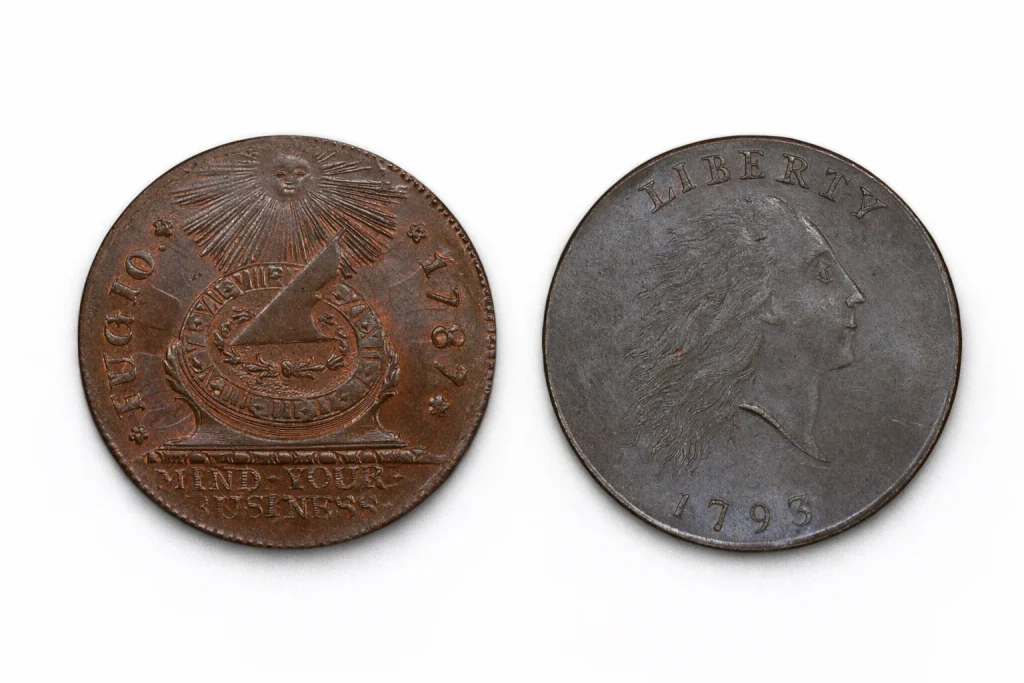
First penny ever made sounds like a question with one answer. In American numismatics, it has two. The 1787 Fugio cent came first under national authority. The 1793 Chain cent came first as the regular one-cent coin of the new U.S. Mint. That is why collectors still argue about it. The answer changes with the definition.
This is not a technical trick. It is the real history of early American coinage. One coin belongs to the Confederation period. The other belongs to the federal Mint era. Both matter. Both changed the story of money in the United States.
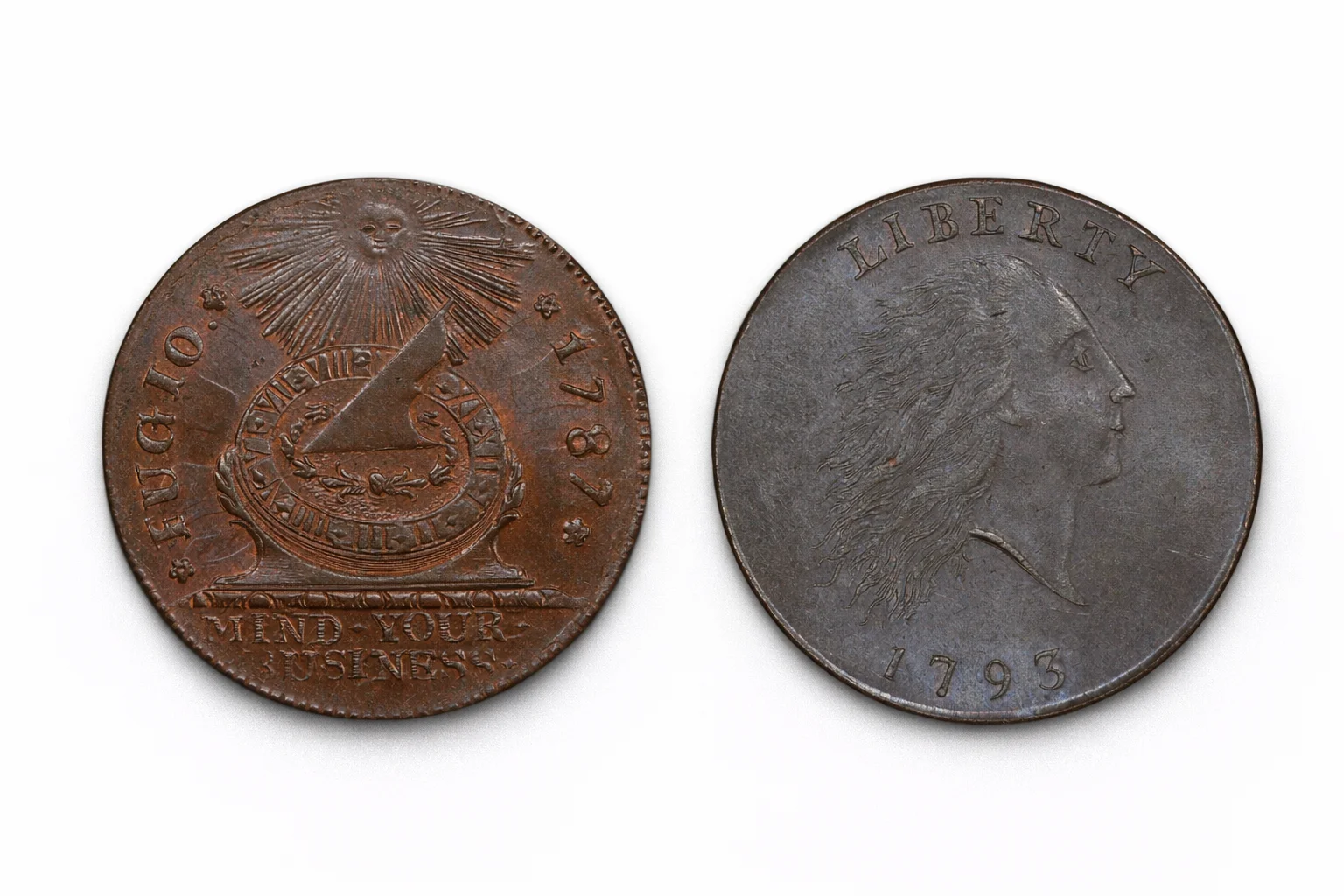
Two Different Answers to the Same Question
The easiest way to read the subject is to separate the two meanings of “first.”
| Coin | Why It Can Be Called First | Best Short Definition |
| 1787 Fugio cent | First coin issued under the authority of the United States | First federally authorized American cent |
| 1793 Chain cent | First regular one-cent coin produced by the U.S. Mint | First regular U.S. Mint penny |
That table solves most of the confusion. The Fugio cent is earlier. The Chain cent is the first regular Mint cent. Both claims are valid. They just describe different stages of the same national story.
The Fugio Cent Came First
If the question is purely chronological, the Fugio cent wins. PCGS states that Fugio cents were the earliest coins issued by the authority of the United States. The Congress of the Confederation resolved in 1787 to issue the first national coinage, the copper cents now known as Fugio cents. That puts the Fugio cent first in the legal and political sense.
The design helps explain why the coin is so famous. The obverse shows a sundial with the word FUGIO. The phrase MIND YOUR BUSINESS appears below. The reverse uses linked rings to represent the states. Smithsonian links the design to Benjamin Franklin’s message about time and work. Britannica also notes the ring-chain symbolism on early American coinage.
The Fugio cent also feels different from later federal coins because it does not belong to the regular Mint system that collectors usually think about when they picture early U.S. coins. It stands at the transition point between political authority and national coin production. That is why some writers call it the first American penny with no hesitation.
Why Collectors Still Point to the Chain Cent
The 1793 Chain cent belongs to a different category. It was the first regular one-cent coin struck by the United States Mint. That point matters. The Fugio cent came earlier, but the Chain cent begins the regular federal Mint cent series. For that reason, many collectors treat it as the first real U.S. penny.
This is not just a matter of wording. The Chain cent belongs to the first working year of the Philadelphia Mint. It is part of the federal coinage system that most collectors recognize as the real start of regular U.S. Mint production. In practical collecting, that makes it the stronger “first Mint penny” answer.
The Chain Cent Was a Short-Lived Type
The Chain cent did not last long. That helped make it famous. PCGS notes that a total of 36,103 Chain cents were struck from late February into March 1793. Heritage repeats that same mintage range in its descriptions of the issue. For such an important coin, that is a short and narrow start.
The design also caused trouble. The reverse showed a chain meant to symbolize union. The public reaction was not strong. Contemporary criticism read the chain as harsh and negative. Modern historical writing still points to that problem. The type was replaced quickly. That short life gave the coin an even stronger place in American numismatic history.
So Which Coin Is Really the First American Penny?
The practical answer is simple.
- If the question means the first federally authorized American cent, the answer is the 1787 Fugio cent.
- If the question means the first regular U.S. Mint penny, the answer is the 1793 Chain cent.
This is the cleanest way to explain the subject to collectors and non-collectors at the same time. It keeps the history accurate and the answer readable.
Design And Symbolism
The two coins matter for more than chronology. Their designs show two stages of the American idea.
Fugio Cent
Main ideas:
- Time passes;
- Work matters;
- The states must stay united.
Chain Cent
Main ideas:
- Federal authority;
- Liberty as a national symbol;
- The union of the states through the chain reverse.
The visual message changed from moral instruction and political symbolism on the Fugio cent to regular national coin identity on the Chain cent. That shift is part of why the two coins work so well as a pair in early American numismatics.
Value And Market Position
Both coins are expensive compared with later cents. The Chain cent usually carries the stronger trophy status in regular federal cent collecting. The Fugio cent is still a major historical coin, but it often sits at a different market level.
| Coin | Typical Market Position | Practical Value Pattern |
| Fugio cent | Early national authority coin | Historic, scarce, value depends on variety and grade |
| 1793 Chain cent | Early federal Mint trophy coin | Stronger prestige in early U.S. cent collecting, expensive even in low grades |
That is the big picture. The Chain cent is usually the bigger prize in the classic “first Mint cent” narrative. The Fugio cent is the earlier political starting point. Both are serious collector coins.
How Much Does a Fugio Cent Cost?
Fugio cents are expensive, but they usually cost less than Chain cents. Price depends on variety, grade, surfaces, and whether the coin has problems. A lower collectible grade can still stay in the low thousands. Mint State pieces move much higher.
| Level | Example Market Range | What It Means |
| Mid-grade collectible piece | about $1,920 | Serious collector coin, but still obtainable |
| Mint State examples | about $8,500–$12,000 | Stronger market, much harder to buy |
This pricing pattern matters because Fugio cents are not bought by date alone. Collectors also look at die variety, historical subtype, and surface quality. That is why two 1787 Fugio cents can sell at very different levels.
How Much Does a Chain Cent Cost?
The Chain cent sits in a much tougher market. NGC says most collectors seeking one must settle for grades from About Good through Very Good, and that higher-grade pieces are rare and expensive. That one sentence says a lot about the issue. Even low-grade examples are significant coins.
PCGS auction records show that low-grade Chain cents already sell in the several-thousand-dollar range. Higher-grade pieces jump much further. This is why the Chain cent is often treated as a major landmark coin rather than just another early copper cent. The cost of entry is high, and the upper end is much higher.
Can You Actually See Either Coin Today?
Yes. Both survive. Neither is a myth. Neither exists only in books.
You are most likely to see them in:
- Major auction previews;
- Specialist dealer inventories;
- Museum collections;
- Digital auction archives.
Smithsonian holds a Fugio cent in its national collection. Chain cents appear regularly in major auction archives and early American copper sales. That means the first American penny, however defined, is still visible today. It is just not something most people will see in everyday museum traffic or local coin shops.
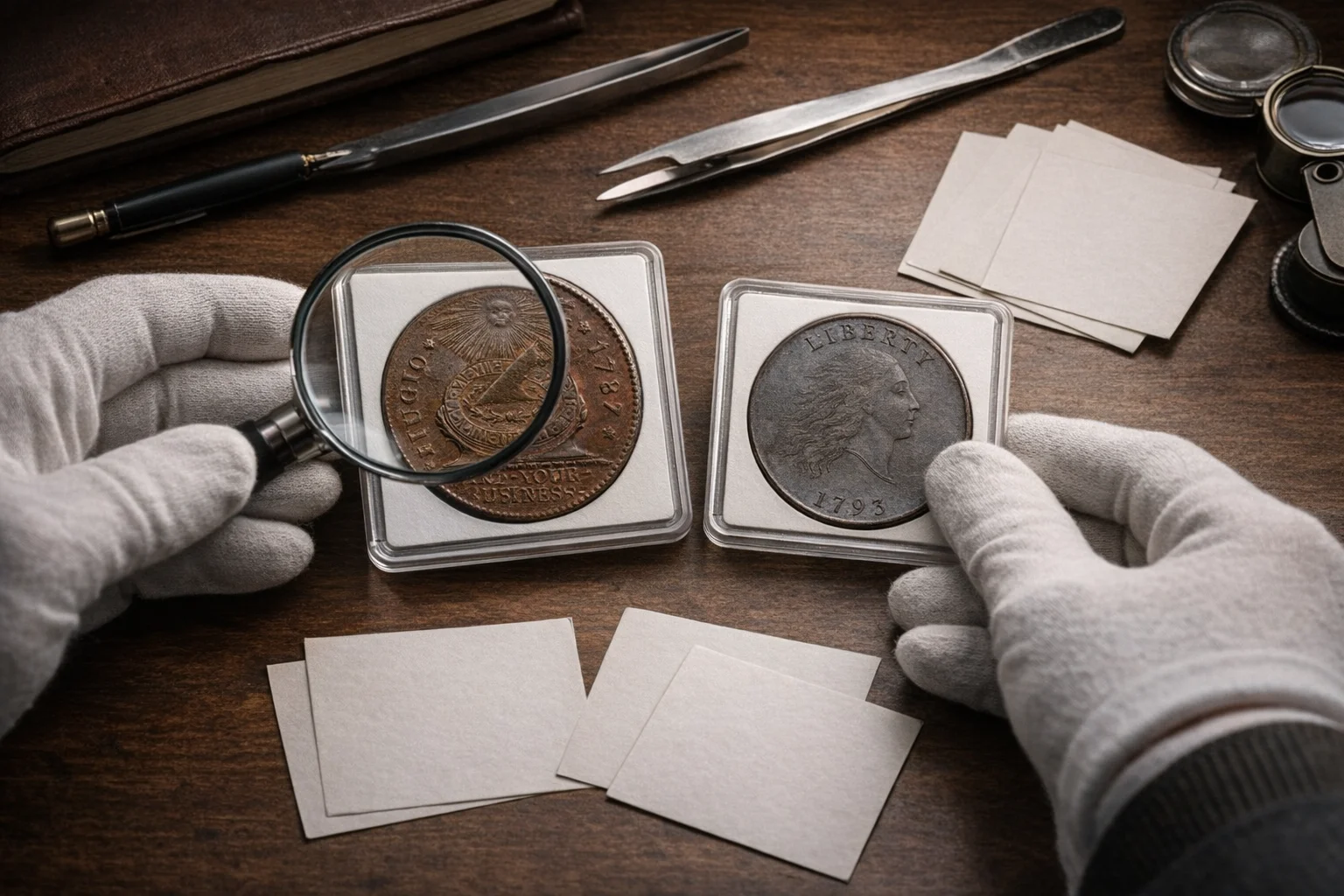
Which Coin Do Collectors Usually Mean?
In practice, the answer depends on the collector.
- A collector focused on early federal authority may lean toward the Fugio cent.
- A collector focused on regular U.S. Mint coinage usually leans toward the Chain cent.
That split is normal. It reflects the two valid meanings of “first.” It is also why the question keeps returning in articles, auctions, and collector discussions. The best answer is not one coin against the other. The best answer is to explain why both matter.
Practical Collector Use: When collectors compare early U.S. cents and try to keep Fugio and Chain cent references organized, a free coin scanner app can help store coin details, separate historical categories, and keep different one-cent types inside one group. That is useful here because the whole question depends on classification, not on one coin simply replacing the other.
Conclusion
The question sounds simple, but the history is better than the slogan. The 1787 Fugio cent came first as the federally authorized American cent. The 1793 Chain cent came first as the regular one-cent coin of the U.S. Mint. One belongs to the national authority. One belongs to regular Mint production. Both changed American money history.If you have any numismatic issues, remember to rely on the best coin identifier app. Coin ID Scanner will be useful for coin ID, organizing collections, and checking current market prices.